Care Guide
Five Signs Your Painting Needs a Conservator
Most damage announces itself quietly, long before it becomes urgent. Here is what to look for — and what can wait.
Minute read
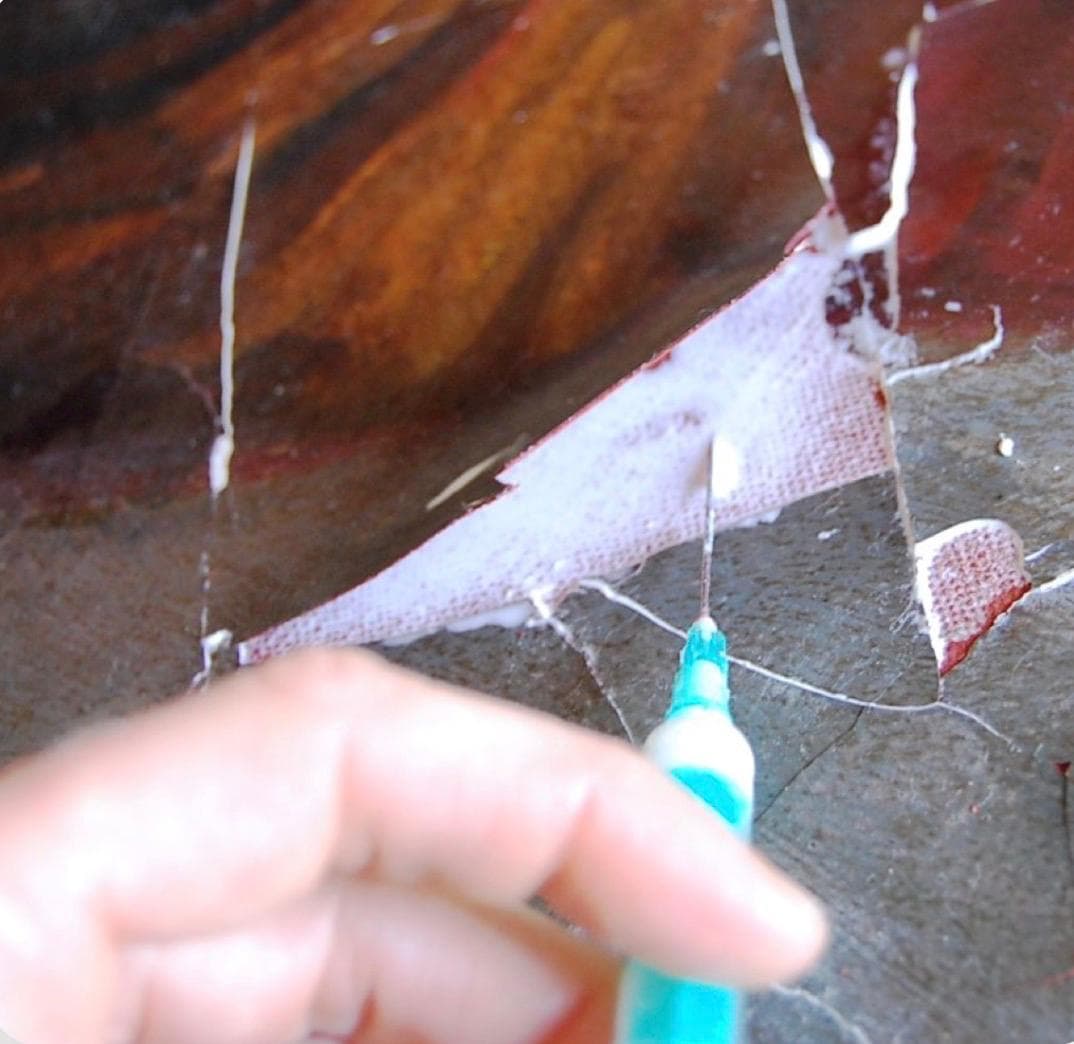
Paintings rarely fail suddenly. The damage that brings a work to our studio almost always began years earlier, as a small change too gradual to notice day to day. Learning to read those early signs is the single most useful thing a collector can do — because the earlier a problem is caught, the smaller and less costly the intervention.
None of the signs below means you should reach for a cloth or a bottle of anything. They mean it is worth a conversation with a conservator. Here is what we look for.
1. A yellow or brown veil over the whole image
Natural-resin varnishes oxidise and yellow with age. Because the change is even and slow, the eye adjusts — until a cleaned area reveals just how much colour was hidden. If your painting looks uniformly warm, muddy, or dull, the cause is often the varnish rather than the paint beneath it.
2. Fine cracks that have begun to lift
A network of fine cracks — craquelure — is normal and, in an old painting, expected. What matters is whether the edges of those cracks are flat or lifting. Lifting or 'cupping' paint catches the light in tiny ridges and signals that the paint layer is losing its grip on the ground. This is the point at which consolidation prevents loss.
3. A slack canvas or visible distortion
Press gently near the edge — never on the image — and notice whether the canvas gives like a drum or sags. A slack support stresses the paint every time the work is moved. Bulges, dents, and a wavy surface in raking light all point to structural issues worth addressing before they become losses.
4. Flaking, powdering, or a 'blanching' bloom
Tiny flakes at the base of the frame, a chalky surface, or a pale, cloudy bloom in dark passages all indicate that something in the layered structure of the painting is changing. These are not cosmetic; they are early structural warnings.
5. Anything that has been 'touched up' before
Earlier restoration is not necessarily bad — but old retouching and overpaint discolour at a different rate to original paint, and what was once invisible can become a distracting smear. If you can see where someone has worked before, it may be time to review that intervention.
If you recognise your painting in any of these, the next step is simple: photograph it in even daylight and send the images to a conservator. Often the advice will be reassuring. When it isn't, you will have caught the problem early — which is exactly where you want to be.
Written by Smriti Rajput, Art Revive Studio.
All journal entries
Begin
Let's discuss your work.
Share a few photographs and a conservator will respond personally within two business days — complimentary, confidential, and without obligation.