Service · 05 / 07
Sculpture Conservation
Three-dimensional works fail differently to paintings and paper. Bronze corrodes electrochemically, wood moves with the grain and the season, stone and ceramic fail structurally — each material asks to be understood on its own terms before it's touched.
Our approach
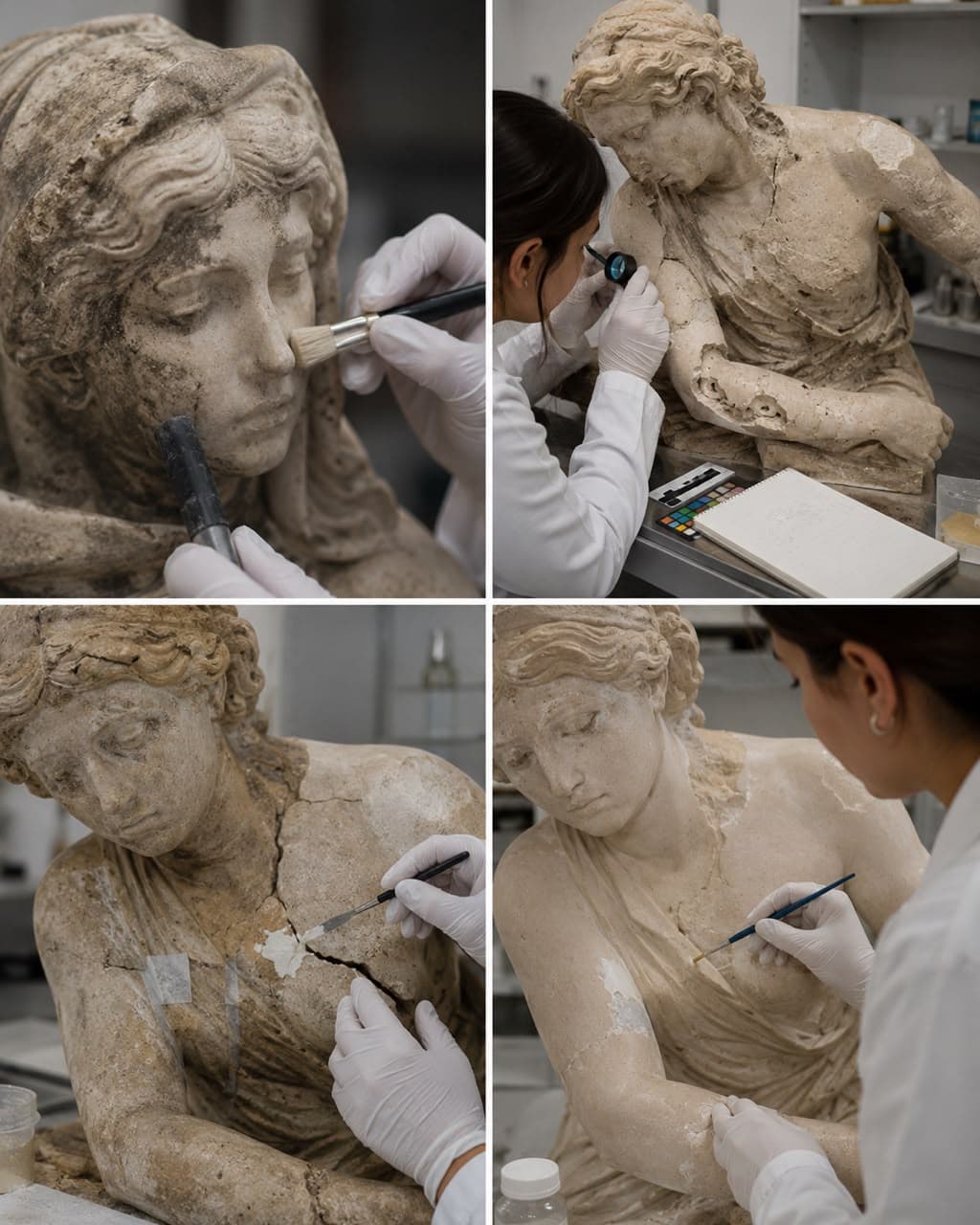
Examination begins with photography under normal, raking, and ultraviolet light, alongside a structural and surface assessment that identifies the material, any prior restoration, and how the object was originally made and mounted.
Where a material question needs a firmer answer, XRF analysis, cross-section microscopy, or corrosion evaluation follows — checking not just the surface but the object's structural integrity: fractures, old repairs, internal armatures, and the stability of its mount or support.
Cleaning, consolidation, and repair proceed material by material and are documented at every stage, finished with an appropriate protective measure — microcrystalline wax on metal, a consolidant on friable stone or ceramic, a barrier coating where needed — and guidance for display or storage. Culturally significant or sacred objects are treated only after proper consultation and consent.
What's included
- Material & condition examination
- XRF & cross-section analysis
- Structural & mount stability assessment
- Surface cleaning
- Structural consolidation & repair
- Corrosion treatment
- Protective coatings (wax, consolidant, barrier)
- Loss compensation & handling advice
Ideal for
- Bronze, stone & ceramic objects
- Wood, ivory & polychrome pieces
- Antique & terracotta heirlooms
- Mixed-media & composite works
Other disciplines
Condition Assessment
Examination under raking light, ultraviolet, and infrared — with XRF, radiography, or microscopy where a question calls for it — to document a work's true condition before any treatment is proposed.
- UV & infrared examination
- XRF & material analysis
- Written condition reports
Paintings Conservation
Examination, cleaning, and restoration of paintings — from Indian modern masters to contemporary works in oil, acrylic, and mixed media.
- Surface cleaning
- Consolidation
- Inpainting
Paper Conservation
Specialist conservation of prints, drawings, manuscripts, watercolours, pastels, and archival material — foxing, acidity, tears, and discolouration.
- Foxing & stain reduction
- De-acidification
- Tear & loss repair
Textile Conservation
Cleaning, stabilisation, and support repair for textiles and embroidered or woven works — from fragile antique weaves to family heirlooms.
- Surface & wet cleaning
- Support stitching
- Mount & display prep
Preventive Conservation
Protecting collections before damage occurs — climate and light guidance, storage and handling audits, condition surveys, and emergency response.
- Condition surveys
- Climate & light guidance
- Emergency response
Documentation & Reports
Full photographic and written records of every treatment — condition reports, material analysis, and a complete conservation dossier, prepared to museum and insurance standards.
- Condition reports
- Photographic documentation
- Treatment dossiers
Begin
Let's discuss your work.
Share a few photographs and a conservator will respond personally within two business days — complimentary, confidential, and without obligation.