Textile Painting
Buddhist Silk Painting
Central Asian Buddhist tradition · Silk Road antiquity · Painting on silk chiffon
In the studio
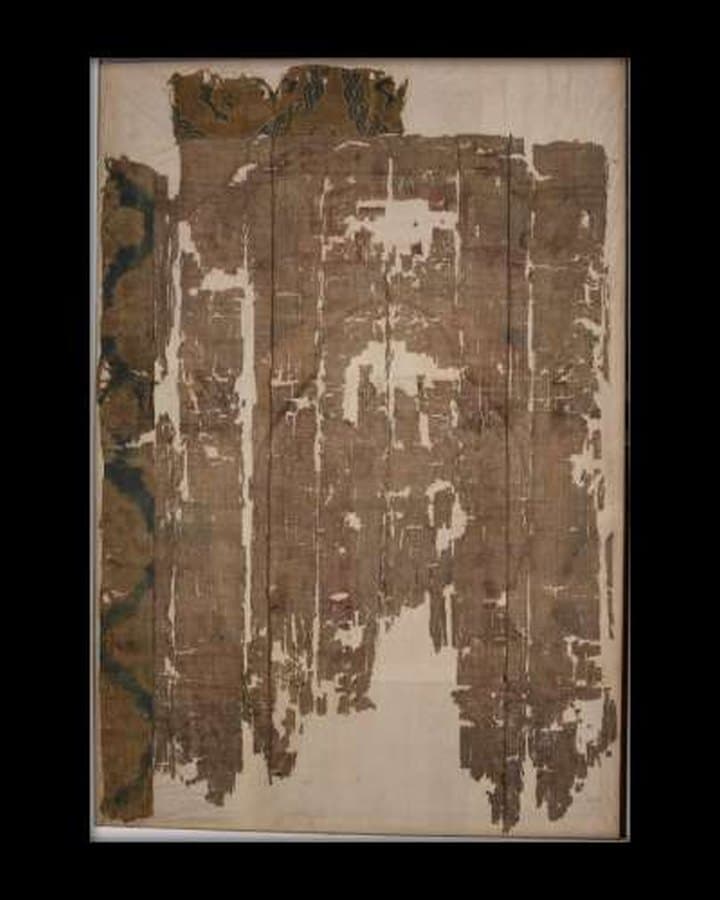
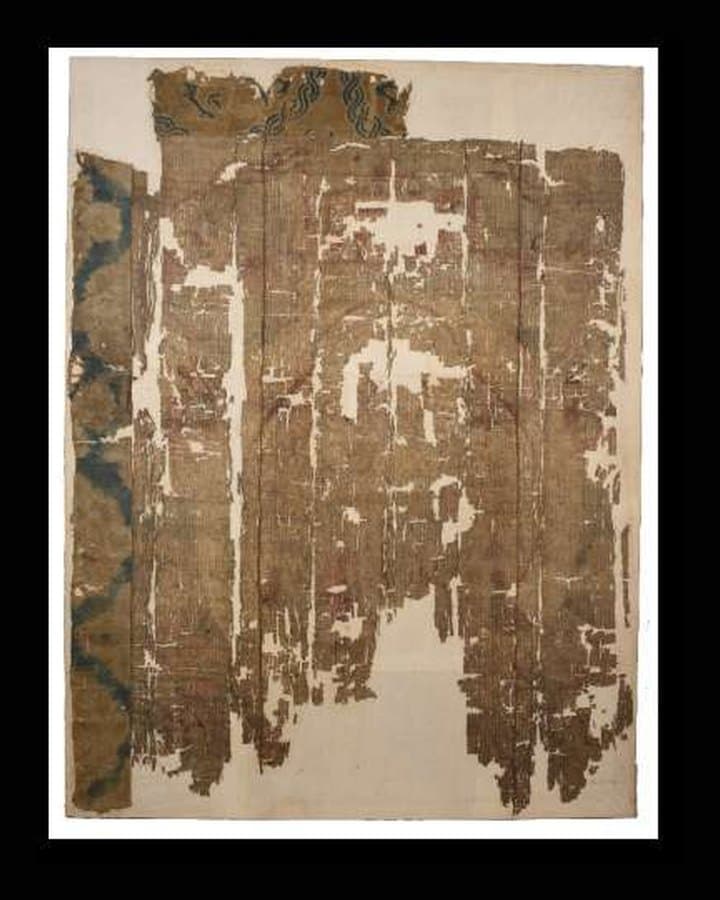
Drag the handle to compare the work as received with the work as returned.
The Story
Conservation began, as always, with photographic documentation and a detailed condition report. A loose fibre was studied under the microscope at 40× and identified as silk chiffon — a transparent, almost weightless weave of alternating S- and Z-twist crepe yarn, still carrying traces of an old adhesive.
The painting was extraordinarily damaged: fragmentary, faded, stained, and losing adhesion to its backing in many places. Cleaning began dry, then progressed to closely-controlled solvent tests before any aqueous work. Waviness was relaxed with measured moisture, and two holes at the centre were filled by the paper-pulp method — fine tissue fibres bound with adhesive, burnished, and dried under pressure.
A water stain was reduced with an ethanol–water mixture at 20:80 — the ratio that tested best — and the tears and cuts on the reverse were mended by patch and strip lining, both to strengthen the work and to keep insects from entering through the losses. What had survived only in fragments was, at last, stable.
- The Damage
- One of the most fragile works imaginable — a Buddhist silk painting surviving only in fragments. Deep dust and dirt, faded natural pigments (indigo blue, madder red, hazel-bark black), stains, missing areas, losses in the paint layer, and a widespread loss of adhesion between the painting and its backing.
- The Process
- Microscopy identified the textile as silk chiffon, woven from alternating S- and Z-twist crepe yarn. Treatment followed: dry cleaning, controlled solvent patch-tests, moisture treatment to relax waviness, paper-pulp filling of central holes, water-stain reduction with ethanol and water at 20:80, and tear-mending of the support by patch and strip lining.
- The Outcome
- Cleaned, consolidated, and structurally supported, the fragile silk was made safe to handle, store, and study — its surviving image stabilised against further loss.
Specifications
- Support
- Silk chiffon (S/Z crepe yarn)
- Dimensions
- 150.2 × 115 cm
- Pigments
- Indigo · madder · hazel-bark
- Accession
- Ch.00103 · 2003/17/271
Techniques applied
- Microscopic fibre analysis
- Paper-pulp loss filling
- Water-stain reduction (20:80)
- Strip-lining the support


Begin
Let's discuss your work.
Share a few photographs and a conservator will respond personally within two business days — complimentary, confidential, and without obligation.